UPDATED ON 23 OCTOBER 2026
Homemade energy bar: the oat and date recipe
A homemade energy bar can work as a snack or top up your fuelling on an easy run. This no-bake version combines oats, dates, honey and almond butter. The ingredients are weighed so the portions are comparable and you can estimate their carbs.
Fibre and fat aren’t always a good fit during hard efforts. Start with a small portion in training: a homemade recipe isn’t automatically easier to digest.
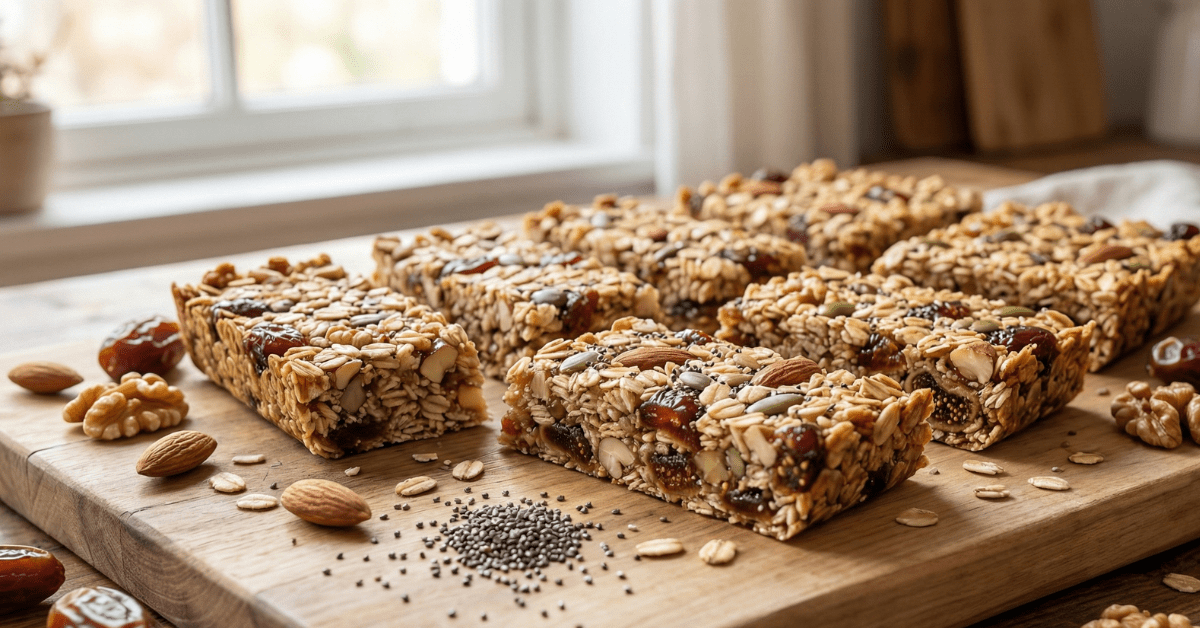
Recipe for 10 oat, date and honey bars
No-bake preparation. Choose soft dates and a smooth, well-mixed almond butter. Chilling makes the bars easier to cut; it doesn’t sterilise them.
Ingredients
- 120 g of small rolled oats
- 160 g of soft pitted dates
- 60 g of liquid honey
- 40 g of almond butter
Method
Check that the dates contain no pits. Briefly blitz the oats to break up the larger pieces, without necessarily turning them into flour.
Blend the dates with the honey and almond butter. Pause if the food processor heats up. The paste should become sticky; use soft dates rather than adding a lot of water.
Mix with the oats until the binder is evenly distributed. Press a small amount between clean fingers: it should hold together. If the mixture crumbles, blend the binder some more or add a little weighed honey, then adjust the nutrition calculation.
Spread into a small tin lined with baking paper, about 1.5 to 2 cm thick. Press down firmly and cover. Place in the fridge for about 2 hours.
Cut into 10 portions of similar weight, about 38 g each before preparation losses. Wrap each one individually in food-safe material and store in a closed container in the fridge.
Carbs per bar: an estimate based on the labels
Values vary from one product to another. Here is a sample calculation, using 60 g of carbs per 100 g of oats, 65 g for the dates, 82 g for the honey and 6 g for the almond butter:
- Oats: 120 × 60 ÷ 100 = 72 g of carbs.
- Dates: 160 × 65 ÷ 100 = 104 g.
- Honey: 60 × 82 ÷ 100 = 49.2 g.
- Almond butter: 40 × 6 ÷ 100 = 2.4 g.
The total is 227.6 g, or about 23 g of carbs per bar for 10 equal portions. This is an estimate, not a laboratory analysis. Replace the values with those on your own packaging, using the “carbohydrates” line and not just “of which sugars”.
We don’t give a fixed calorie value per bar: changing the portion size, the nut butter or the amount of honey changes the totals.
Before or during a trail run: when should you eat them?
These bars work well as a snack and can top up your fuelling on a run at a comfortable pace if you tolerate them. Their texture takes some chewing: eat them on a quiet stretch or while walking, rather than in the middle of a technical descent.
Start with half a bar, with water on hand, and pay attention to how full you feel and how comfortable your stomach is. A bar rich in dried fruit and oats doesn’t behave like a gel. For hard-running sections at high intensity, you may prefer a less fibrous format.
The Australian Institute of Sport guidelines put intake at 30–60 g of carbs per hour for efforts of 1 to 2.5 hours. Count food and drinks together, then adapt to your run and your tolerance. Two bars from the example provide about 46 g, but that doesn’t mean you should eat two every hour.
Storing and carrying homemade bars
These bars have no validated shelf life. Soft dates, the equipment you use and the moisture in the mixture can all affect how well they hold together and keep. Make a small batch, cover it and keep it at 4 °C maximum.
As a precaution, eat the refrigerated bars within 48 hours, or quickly freeze any portions for later, individually wrapped. Thaw in the fridge and don’t refreeze a thawed portion. This cautious approach is not a microbiological guarantee specific to the recipe.
For carrying, keep them cool as much as possible and avoid long hours in a hot pack. The official kitchen hygiene guidelines recommend chilling prepared foods quickly. For a long race where you can’t keep them cold, choose foods with clearly stated storage conditions.
Variations and common mistakes
Crumbly bars: check how soft the dates are, how fine the oats are and how firmly the mixture is packed. Cutting pieces too thin can also make them more fragile. Bars that are too sticky: leave them to rest in the fridge for longer and cut with a clean knife; adding oats changes the proportions and the carbs per bar.
Without honey: another syrup may work, but you will need to adjust the texture and redo the calculation. Gluten-free: use oats explicitly certified gluten-free, and check the other ingredients as well as cross-contamination. The recipe contains almonds; swapping them for peanut butter introduces a different allergen.
Keep your first version simple. Adding nuts, seeds, chocolate and dried fruit all at once makes it harder to work out what you digest well. Write down your quantities so you can reproduce the recipe.
Frequently asked questions
Are these protein bars?
They provide some protein from the oats and almonds, but this recipe is mainly designed as a carbohydrate snack. It was not formulated to deliver a precise dose of protein.
Can you use them in an ultra-trail?
Possibly for part of the course, if you have tested your tolerance and know how well they keep. Don't make them your only fuelling without trying them first, and plan for simpler formats that are easier to carry for a long time in the heat.
Can you replace the dates with raisins?
This changes the binder, the texture and the carbohydrate content. It is not a guaranteed like-for-like swap: test a small batch before making a full lot.
Why weigh the portions?
Weighing helps spread the carbs more evenly. Ten pieces that look different won't each provide a tenth of the mixture.
Mixing up your fuelling formats
Alternate textures according to your preferences and the conditions of your run. For a drinkable option, see our honey gel recipe.